
Travelling here means becoming part of the story.
Here, the island isn’t just home – it’s part of who we are. Days are guided by the rhythms of tide and season, while traditions and community ties remain as steady as the mountains.
History & Remembrance
Discover the stories that shaped Flinders Island through its small but fascinating museums.
At Furneaux Museum in Emita, you’ll find a remarkable collection of over 8,000 artefacts from the Bass Strait region, along with historic and replica buildings that bring the island’s early days to life.
In Whitemark, Bowman’s History Room — established in 1921 — showcases photographs, shop items, and account books from the much-loved E.M. Bowman & Co. store, tracing its role in island life for more than a century.
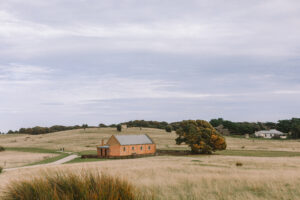
At Wybalenna Chapel in Emita, pause for a moment of reflection. This modest chapel stands as a memorial to the Tasmanian Aboriginal people who were forcibly moved to Flinders Island in the mid-nineteenth century. Nearby, the small Wybalenna cemetery is a place of quiet remembrance, marking this poignant chapter in history.
Flinders Island itself was once known as “Great Island” before being renamed in the early 1800s by Governor King in honour of English navigator Matthew Flinders. Flinders charted much of Bass Strait and its islands—including Mt Chappell Island, which he named for his wife, Anne Chappell.


Aboriginal & European History
When the eastern Bass Strait Islands formed a land bridge between mainland Australia and Tasmania, the region was a pathway for Aboriginal groups moving across Country. Then rising seas flooded the land bridge around 12,000 years ago, the Tasmanian Aboriginal people became separated from their mainland relatives and developed their own distinct culture and practices.
Flinders Island’s story begins with the Tasmanian Aboriginal people, its first residents more than 35,000 years ago. Archaeological evidence suggests the Furneaux Group, of which Flinders is the largest, was occupied seasonally until around 9,000–4,000 years ago.
The next chapter came in 1773, when explorer Tobias Furneaux sighted the islands, though he did not land. In 1797, the ship Sydney Cove, travelling from Calcutta to Port Jackson, ran aground on nearby Preservation Island. This event opened the way for sealing, which became Australia’s first export industry. By 1810, sealskins and oil had already passed their peak, but some sealers—known as the “Straitsmen”—remained, living on the smaller Furneaux Islands.
From 1803 onwards, Aboriginal communities in Tasmania faced violent conflict as European settlement expanded. In 1830, Governor George Arthur, guided by George Augustus Robinson, attempted to relocate Tasmanian Aboriginal people to Flinders Island in the hope of preserving them. Around 200 people were exiled to Wybalenna, but the settlement was tragic: disease and isolation saw most perish within a few years. By 1847, the survivors were removed again to Oyster Cove in southern Tasmania.
Despite these hardships, Tasmanian Aboriginal people live on—many with ancestry connected to both the original communities and the Straitsmen. Today, over 16% of Flinders Island’s population identify as Tasmanian Aboriginal, and their culture remains a vital part of the island’s identity.
The restored Wybalenna Chapel at Emita is the last surviving building from the settlement and a poignant reminder of this history. The surrounding area still shows traces of the original community, mapped by Robinson himself.
Flinders Island has welcomed new settlers over time. The first arrived just before the First World War, and the second came after the Second World War through the Soldier Land Settlement Scheme. These initiatives brought fresh families to the island, boosting both its population and agricultural production.
The book A Job Worth Doing by Claire Konkes shares ten personal stories from families who were part of the Soldier Settlement Scheme between 1952 and 2002, offering a unique glimpse into this chapter of Flinders Island’s history.
Today, the island is home to around 800 people, many of whom work in primary industries. Flinders is known for its high-quality exports, including beef, lamb, wool, crayfish, abalone, shark, and scallops.
For more information:
Flinders Island Aboriginal Association Inc. (FIAAI): (03) 6359 3532
Cape Barren Island Aboriginal Association Inc. (CBIAAI): (03) 6359 3533
